PLEASE KNOW THERE IS A FORMATTING ERROR THAT PERTAINS TO THE PHOTOS FROM MY CELL CAMERA.  I WILL CONTACT THE WP HELP DESK TOMORROW MORNING TO FIND OUT WHAT'S GOING ON.  FIVE ATTEMPTED FIXES IS ENOUGH.  THANK YOU FOR YOUR PATIENCE.

Hiking Indiana State Parks - Central Plain - Mounds State park
by Michael Doyle

Indiana is state filled with hills, flat spaces, lakes,
streams, rivers and the setting of Hoosier dreams within
woodland borders. The human eye can easily determine
these aspects.  But what takes a little research to find
out is that the naturalist John Muir had his beginnings
in this state.  Therein is just another tie in as to what
brought me to this interesting state.  John Muir began
his journey on foot to California following an accident
in Indianapolis, Indiana.  I began my journey from
California in an SUV in 2004 and have remained here
despite setbacks to be remain with my daughters as they
lived their childhoods and now live their teen years and
more rapidly than I'd like are becoming adults about to
live their own sets of adventures.

Beyond the steel mills, Indianapolis 500, and farmland,
are Indiana's natural treasures remaining to be known
and explored. The state's borders have literally been shaped
by nature from Lake Michigan to the North and west, to
being bottomed out by the Ohio River, to the Wabash River
firming up the lower western border, all of Indiana is
marked by a blend of nature and civilization in every
section. Throughout all of this are a myriad of trails to
be walked and from which much can be learned. From these
trails much can be learned about ecology, geology, and
human history calls out to be learned from and embraced.

The Central Plain Region:

This Sunday after church, we began our exploration in the
area we live in, the Central Plain. This is the largest
region within Indiana. It is the area of rolling plains
and farmland that gives the world the wrong impression
that Indiana is a featureless state filled with flatlands.
Three distinct areas belie this misconception by being
filled with deep ravines, canyons, flowing waters, and
the lush vegetation that still lingers on in such areas
as Shades State Park, Turkey Run State Park, and the
Pine Hills Nature Preserve. Even Indianapolis has its
share of scenic beauty along Fall Creek and Eagle Creek
Park. The sandstone deposits that remain as canyons
and ravines are the remnant of the ancient Michigan
River that has long faded before human history.

Mounds State Park:

Had we taken the originally planned easy loop
hike of 1.5 miles, our hike would have lasted
approximately an hour. Though I cannot speak for
any other families, mine is not one that often
ignores the impulse to explore and stretch
beyond such plans. We arrived at the Visitor Center
parking lot and immediately found the center was
not open.  This is one of the smallest state parks
at approximately 280 acres.  It is one of the most
popular, too, possibly because of the ease of urge
to ramble along the paths and trails and make
one's own way.


The extensive earthworks and ceremonial mounds
dedicated to the Sun God and the Earth Mother,
beckon the foot traveler onward and backward
into the past. These mounds were built between
160 BC and 50 AD by the Adena and Hopewell
peoples. The 120 feet around Great Mound has
been subjected to archeological digs in the
1960s that found home awls, ceremonial stone
pipes, pottery shards, spear and arrow points,
and a log tomb. None of which has revealed a
great deal about these peoples who had once
built a great and widespread culture across
what is now the Midwest and Southern regions
of the United States.


Once the visitor center is left, an old settler
home dating from 1819 is found and an easy path
downward is found that leads down to the White
River.


From there easy trails lead to the Great Mound,
and the Fiddleback, Woodland, and Formalhault
Mounds. Although there is no evidence
discovered yet of astronomical activity,
the Fiddleback Mound, marks the spot where the
sun sets on the Summer Solstice.


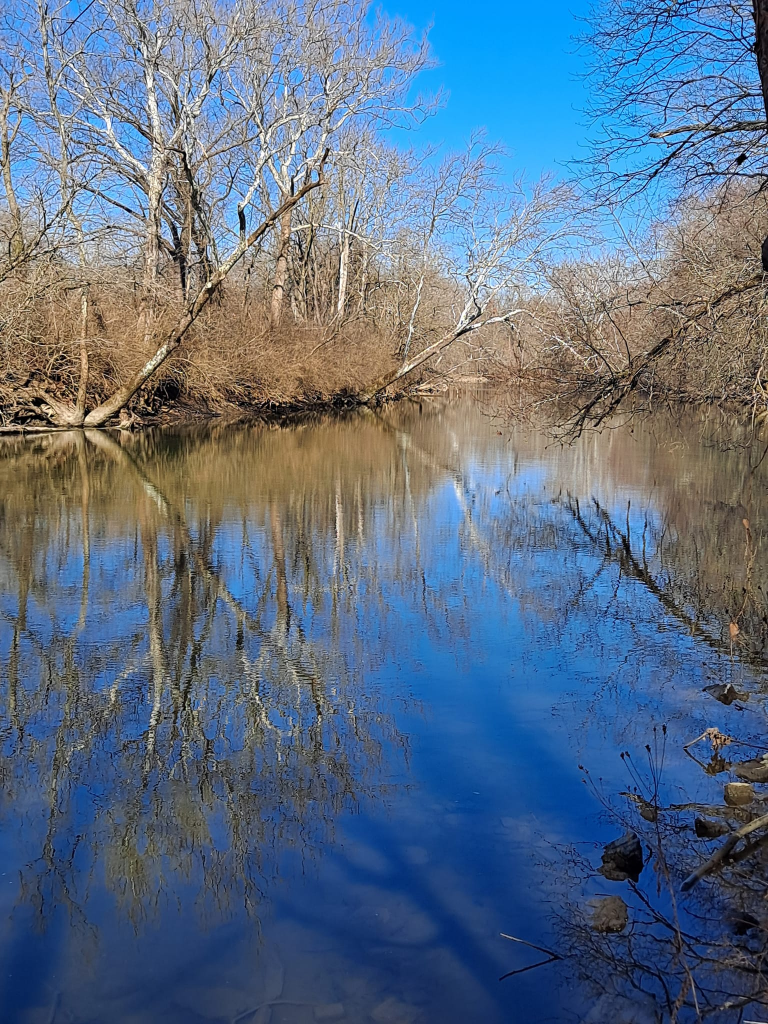
There is a winding walk along the bluff that
overlooks the river. Further down the trail is
a boardwalk.  We, of course, walked the wrong
direction and combined Trail 1 with Trail 5
and then cut across.  My guesstimate is that
we walked approximately 3.5 miles instead of
the 1.5 intended.


There is a curious legend regarding little blue
people.  As I recall, the visitor center had
information about this legend.  However, the
center was closed.  With the picnic tables
there, and historical vantage point, I would
recommend this as a worthwhile stop onward
to other explorations.  Or as a way of
killing time on a Sunday afternoon.

(c) February 13, 2024   Michael Doyle
All Rights Reserved
Heading out of Australia to escape this Aussie winter. First stop Japan, then UK/Ireland and if work doesn't call me back, onto Chicago. I will make it up as I go along





 ALOHA PROMISES FOREVER